-
Sagentia at 25: Medical Innovation at the Speed of Light
Tech company Sagentia celebrates 25 years of innovation in medical technology this month. Robin Lee, Head of IP Exploitation and Technology, reflects on the role the company has played in the development of diode-based medical devices and the opportunities and challenges yet to come.
(August, 2011)
-
How a Virtual Scalpel Overcame Real-World Challenges
A MEMS-based mass flow controller was instrumental in the successful development of a plasma-based surgery system.
(August, 2011)
-
Heating Devices Enhance Operation of Medical Equipment
Electric heaters are used to enhance the operation of various forms of medical and diagnostic equipment. By understanding the product requirements, heater alternatives can be used that simplify medical device design and procurement while reducing size and cost.
(August, 2011)
-
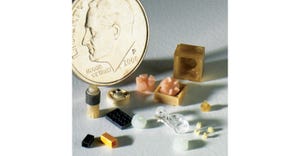
3-D Printing Enables Early Design Verification
A medical device design and production company dramatically reduced its time to market by using 3-D printing to visualise concepts and to test product design and functionality.
(July, 2011)
-
Medical MEMS: How Motion Sensing Is Transforming Next-Generation Medical Device Designs
MEMS-based systems can significantly improve accuracy in aligning hip and knee implants with a patient’s anatomy, reducing discomfort and the need for revision surgery.
(May, 2011)
-
Motion Control Systems: A Drive for Perfection
Advances in stepper motor designs and controls open new possibilities in medical technology and laboratory applications.
(May, 2011)
-
Building a Better Stroke Detector
The P3SENS multidisciplinary consortium aims to develop a biosensor that can detect a stroke sufficiently early to prevent the occurrence of ischemic damage and preserve quality of life.
(May, 2011)
-
IEC 60601-1 Surge Tester Calibration and Check Testing
In addition to helpful techniques that simplify surge testing, this article includes easy-to-implement procedures to ensure that the defibrillation-proof surge tester is working correctly in-between calibration cycles.
(April, 2011)
-
Micropumps for Infusion Therapy
Micropumps can be an attractive alternative to standard pumps because of their size, weight and low energy demand. This article describes one micropump, in particular, which offers the possibility of intrinsic flow control, thereby fulfilling requirements for safety and accuracy under varying condit...
(March, 2011)
-
Sensors that Measure Up
Medical respiration measurements can be improved by using a flow-based differential pressure sensor.
(March, 2011)
-
Medical Device Design at a Crossroads
This year’s Medical Design Excellence Awards saw a strong showing from international entrants. Manufacturers in China and India, in particular, are finding novel ways to cut costs without affecting quality.
(March, 2011)
-
Innovations in the Biofunctionalisation and Terminal Sterilisation of Medical Devices
New enabling technologies are driving growth in the biological products market.
(March, 2011)
-
RFID Inside: Reinventing Navigation Technology for the OR
Complex surgical interventions can be performed faster with fewer postoperative complications when surgeons use state-of-the-art navigation technology. Uptake has been limited, however, because of mechanical limitations and cost. New RFID-based navigation systems address those issues.
(March, 2011)
-
The Addictive Allure of Supercomputing
EMDT's series of interviews offers personal perspectives on the diverse industries that serve the medtech sector. Here, we talk to Andrew Jones.
(March, 2011)
-
MEDTEC Europe Preview: Aid for Postoperative Care after Sternotomy Surgery Developed
MMID is a unique no-nonsense Dutch design agency that applies itself to the development of achievable and successful products in which functionality, manufacturability and design are totally attuned to each other. MMID’s services are targeted at the international healthcare market. The firm&rs...
(March, 2011)
-
Fundamentals of Medical-Grade Power Supplies
When sourcing a power supply for your device, begin by determining how and where the product will be used.
(March, 2011)
-
The Advantages of Strain Gauge Technology
Custom strain gauge sensing technology enhances patient experiences in everything from robotic surgical systems to mammography machines.
(March, 2011)
-
Understanding Superconductivity
Research in high-temperature superconductivity may lead to more-affordable MRI scanners.
(February, 2011)
-
The First Million Bucks
Medical device companies spend around 1 million euros at the front end of every device development project to get to a product concept that they believe in (at least on paper). Some spend it better than others.
(February, 2011)
-
A Framework for Users’ Involvement in Medical Device Technology Development and Evaluation
Effectively surveying prospective device users can lead to improved product functionality, usability, safety and quality.
(January, 2011)
-
Piezo Actuators: Driving Perfection in Microdosing Applications
Automated dispensing of liquids in the nanolitre to microlitre range has become increasingly common in a variety of medical engineering and biotechnology applications. These dispensing systems often call for noncontact pipetting and require the careful selection of a drive mechanism. This article di...
(November, 2010)
-
Optimising the Performance of Injection-Moulded Medical Filtration Devices
The filtration process is vital in device applications such as intravenous infusion, dialysis, blood transfusion and perfusion. This article examines how to achieve greater efficiency and flow from the filter medium. The arterial line blood filter in extracorporeal circulation is chosen to illustrat...
(November, 2010)
-
Understanding the Critical Parameters of Selecting a Liquid Pump
An error in pump selection for a medical device can lead to manufacturing problems, device failures and reputation-damaging product returns. Here are some of the most important parameters to take into account when choosing a pump.
(October, 2010)
-
A Primer on Quality System Regulation
The road to compliance for medtech manufacturers begins with a robust quality system. This article details QSR milestones and includes a roadmap to help reach that destination.
(October, 2010)
-
The Way to Wireless
Wireless medical devices offer increased patient comfort and unprecedented monitoring possibilities. But first, it’s important to optimise power consumption.
(October, 2010)